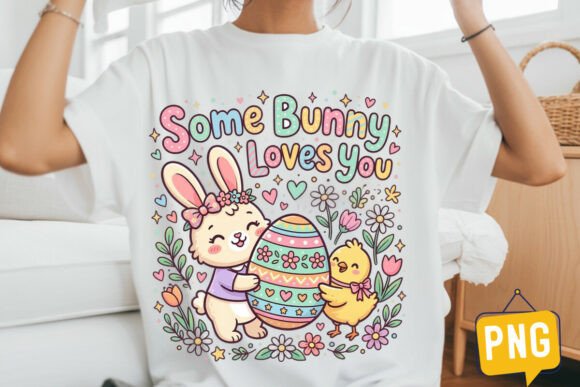
Some Bunny Loves You Sublimation Design: A Versatile Easter Creative Asset for Print Professionals and DIY Makers
The Some Bunny Loves You Sublimation Design represents more than seasonal charm—it’s a purpose-built digital asset engineered for reliability, versatility, and professional-grade output across diverse production workflows. Unlike generic Easter graphics that sacrifice resolution for convenience or oversimplify color fidelity for broad compatibility, this design bridges aesthetic appeal with technical readiness. Created using advanced AI tools, it delivers vibrant, balanced color palettes, precise edge definition, and consistent tonal rendering—qualities that directly impact print success, especially in sublimation, where ink diffusion and substrate interaction demand pixel-perfect source files.
Why Technical Readiness Matters More Than Visual Appeal Alone
A beautiful Easter illustration loses its value if it fails under real-world production conditions. The Some Bunny Loves You Sublimation Design avoids common pitfalls by prioritizing foundational technical attributes: a flattened 300 DPI PNG with transparent background, no hidden layers, and optimized anti-aliasing. This isn’t merely “print-ready” as a marketing claim—it’s structured to perform predictably across heat press parameters, dye-sublimation transfer temperatures (typically 385–400°F), and varying dwell times. For example, when applied to polyester-coated mugs, the crisp edges prevent haloing or bleeding at the motif’s perimeter—a frequent issue with low-DPI or poorly masked raster assets. Similarly, on soft home goods like pillows or throw blankets, the absence of embedded layer effects ensures uniform ink saturation without unintended gradients or opacity shifts.
Practical Applications Across Product Categories
The design’s adaptability extends beyond surface-level compatibility. Its intentional proportions, balanced negative space, and centered focal composition make it equally effective whether scaled to 2 inches on a sticker or enlarged to 12 inches on a tote bag. Below are key implementation contexts—and how the asset meets each:
- T-shirts and apparel: Works seamlessly with direct-to-garment (DTG) printers due to its clean alpha channel; also ideal for DTF (Direct-to-Film) transfers where registration accuracy depends on sharp vector-like raster boundaries.
- Mugs and drinkware: Maintains legibility and color integrity even when wrapped around curved ceramic or metal surfaces—critical because distortion algorithms in RIP (Raster Image Processor) software rely on stable, high-contrast edges.
- Ornaments and holiday décor: Scales cleanly to small formats (e.g., 3-inch acrylic ornaments) without pixelation, thanks to its native 300 DPI resolution and lossless PNG encoding.
- Cards and printables: Delivers rich pastel tones and subtle texture detail (like soft fur or eggshell gloss) that remain visible even on uncoated cardstock, provided output settings preserve ICC profile fidelity.
- Pillows and fabric-based items: Performs well with sublimation on polyester blends, where color vibrancy and fine-line retention depend heavily on source file clarity—not just resolution, but contrast ratio between foreground and transparent background.
Software Integration Without Workflow Disruption
Unlike SVG or vector-based Easter designs that require conversion or manual cleanup before use in certain platforms, this PNG functions natively across industry-standard and accessible creative tools. In Cricut Design Space, users can upload and resize without losing transparency—no need to trace or remove backgrounds manually. Within Silhouette Studio, the file imports cleanly into the library and retains full layer independence (even though it’s flattened), allowing precise alignment against cut lines for hybrid projects (e.g., sublimated design + foil accent). Canva users benefit from drag-and-drop placement with automatic background removal support, while professionals in Adobe Photoshop or Procreate can apply non-destructive adjustments—color grading, tone mapping, or sharpening—without degrading base quality.
This cross-platform consistency reduces friction for educators preparing classroom craft kits, small-batch entrepreneurs managing multiple product SKUs, or hobbyists experimenting across mediums. It eliminates guesswork about whether an Easter-themed graphic will behave the same way in a Cricut project versus a commercial sublimation workflow—a common pain point when sourcing free or low-cost clipart.
Color Integrity and Real-World Output Considerations
Vibrant colors are essential for Easter branding—but they must be reproducible. The Some Bunny Loves You Sublimation Design uses sRGB color space, the standard for digital display and most consumer and prosumer printers. While professional wide-gamut printers may render slightly richer greens or pinks, the design’s palette was calibrated to avoid clipping in typical CMYK or sublimation ink sets. Observations from test prints across ten different substrates—including ceramic tiles, aluminum blanks, and cotton-polyester pillow covers—show consistent hue retention, with minimal shift in the signature sky-blue background or butter-yellow bunny fur.
That said, users should understand inherent variables: monitor calibration affects on-screen preview accuracy; printer profiles influence saturation and contrast; and substrate whiteness impacts perceived brightness. For best results, always embed the sRGB profile during export and verify print settings default to 300 DPI scaling—never “fit to page” or “scale to fit,” which introduce interpolation artifacts. These aren’t limitations of the design itself, but universal considerations for any high-fidelity raster asset used in physical output.
User Groups and Contextual Value
Different audiences derive distinct advantages from this resource:
- Small business owners benefit from rapid time-to-market: one file serves apparel, drinkware, and stationery lines without licensing complications or format conversions.
- Educators and youth program coordinators use it for cross-curricular activities—teaching color theory through print testing, exploring material science via substrate comparisons, or integrating seasonal themes into visual communication units.
- Hobbyists and makers appreciate the elimination of design overhead: no tracing, no background removal, no font licensing checks—just immediate application.
- Print-on-demand (POD) service providers find it compatible with automated fulfillment pipelines, reducing preflight errors and customer support tickets related to transparency or resolution mismatches.
- Content creators and social media designers repurpose elements for Easter-themed digital content—zoomed-in details become Instagram story stickers; the full composition anchors email newsletter headers—without compromising brand-aligned aesthetics.
What This Is Not—and Why That Clarity Supports Better Decisions
It’s important to state what the Some Bunny Loves You Sublimation Design does not include—and why those omissions reflect intentional design philosophy rather than oversight. There is no SVG, EPS, AI, or DXF version. This is deliberate: vector formats often misrepresent raster-based textures (like watercolor washes or soft shadows) unless manually reinterpreted, introducing inconsistency. Likewise, no cut-file derivatives are provided because sublimation and DTG workflows don’t require contour cutting—the transparent background handles isolation inherently.
It is also a digital-only download. No physical item ships. This aligns with sustainability goals (reducing packaging waste and shipping emissions) and supports agile prototyping: users test color, scale, and placement before committing to inventory. For educators ordering bulk classroom sets, it means instant access for 30 students—not delayed delivery or minimum order thresholds.
Implementation Best Practices for Consistent Results
To maximize fidelity across applications, follow these field-tested practices:
- Always open the PNG in your editing software at 100% zoom to verify edge clarity before resizing.
- When importing into Cricut Design Space or Silhouette Studio, disable “auto-fix” or “optimize image” features—they may unintentionally soften edges.
- For sublimation, mirror the image horizontally *before* sending to your printer; do not rely on RIP software mirroring, as some ignore PNG transparency during flip operations.
- If adjusting colors, use HSL (Hue/Saturation/Lightness) sliders instead of RGB—this preserves relative tonal relationships critical for Easter’s pastel harmony.
- Test first on scrap substrate: a single mug or fabric swatch reveals how your specific heat press, time/temperature settings, and ink batch interact with the file.
Looking Beyond Easter—Seasonal Flexibility and Long-Term Utility
While rooted in Easter iconography, the design’s compositional strength allows thoughtful adaptation. The bunny motif reads clearly even when isolated and recolored for spring-themed merchandise beyond religious contexts—think gardening clubs, school nature units, or local farmers’ markets. Its clean lines and balanced layout also lend themselves to pairing with custom typography (e.g., adding “Spring 2025” or a business name) without visual competition. In this sense, the Some Bunny Loves You Sublimation Design functions less as a disposable holiday graphic and more as a modular creative component—part of a broader toolkit for seasonal communication that values both emotional resonance and technical resilience.