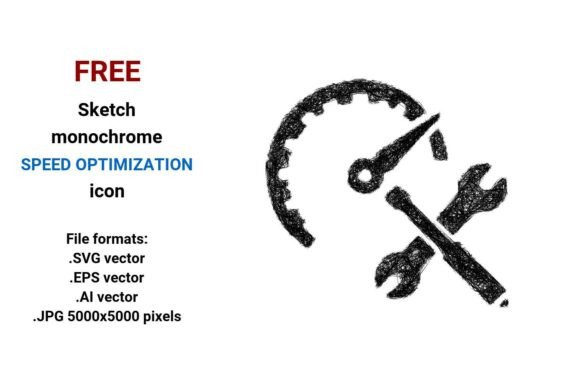
FREE Sketch Speed Optimization Icon: A Versatile Vector Resource for Performance-Focused Design
When visual communication meets technical intent—especially around performance, efficiency, and digital health—the right icon can bridge abstract concepts with immediate recognition. The FREE Sketch Speed Optimization Icon stands out not just for its aesthetic character, but for how it meaningfully represents page speed, optimization, and intentional design in a format that’s both expressive and technically robust. Unlike flat, generic symbols, this icon family embraces a handdrawn sensibility—think pencil sketch icon energy, line art precision, and UI button clarity—all while delivering production-grade vector fidelity.
What Makes This Icon Set Uniquely Practical?
At its core, the FREE Sketch Speed Optimization Icon is more than decoration—it’s a functional asset built for real workflows. It ships in four widely supported file formats: .SVG vector, .EPS vector, .AI vector, and .JPG at 5000×5000 pixels. That combination ensures adaptability across contexts: SVG for responsive web interfaces where page speed and scalability matter; EPS and AI for print-ready collateral or high-fidelity mockups in Adobe Creative Cloud; and the ultra-high-res JPG for presentations, documentation, or platforms that don’t support vector imports.
This multi-format availability directly supports diverse user needs—from developers embedding lightweight SVGs to reduce render-blocking resources, to educators illustrating speed optimization principles in lecture slides, to product managers annotating wireframes with intuitive speed optimization button callouts. Each format preserves the icon’s essential qualities: clean linework, balanced negative space, and expressive imperfection—hallmarks of a handdrawn vector icon that feels human without sacrificing professionalism.
Why Vector Matters—Especially for Speed & SEO Contexts
A vector image is fundamentally different from raster graphics. Rather than relying on fixed pixels, it uses mathematical equations to define points, lines, and curves—making it infinitely scalable without quality loss. That trait is critical when designing for variable screen sizes, high-DPI displays, or responsive layouts where page speed depends partly on asset efficiency.
Consider this: an SVG version of the FREE Sketch Speed Optimization Icon typically weighs under 3 KB—far lighter than even a compressed PNG of comparable visual impact. When used as inline SVG in HTML, it eliminates HTTP requests entirely. For SEO professionals auditing Core Web Vitals, that translates directly into improved page speed scores—particularly for metrics like Largest Contentful Paint (LCP) and Cumulative Layout Shift (CLS), where unnecessary image reflows or oversized assets degrade performance.
Moreover, vector files are inherently editable. Designers can adjust stroke weight, color, or composition directly in Illustrator or Figma. Developers can style SVG paths with CSS or animate them with JavaScript—enabling dynamic states like “optimizing…” or “complete” without loading multiple assets. That flexibility reinforces the icon’s role not just as static imagery, but as part of a living UI kit supporting iterative, performance-aware development.
Design Language: Sketchy Authenticity Meets Functional Clarity
The icon’s visual voice sits deliberately between illustration and utility. Its pencil sketch icon foundation evokes thoughtfulness and intention—qualities central to genuine optimization. Yet it avoids excessive flourish: no heavy shading, no ambiguous gestures. Instead, it relies on confident line art sketch strokes—a circular motion suggesting acceleration, a subtle upward arrow embedded in the form, or a stylized gear integrated with organic flow.
This duality serves multiple audiences. For business owners evaluating tools, the sketchy icon signals approachability—not intimidating technical jargon. For developers reviewing a design system, the clean geometry and consistent stroke width indicate production readiness. And for educators teaching digital literacy, the artistic sketch icon becomes a teachable moment about how abstraction conveys complex ideas: a single curved line can represent data flow, resource reduction, or time saved.
Importantly, the black-and-white variant expands accessibility. High-contrast monochrome rendering ensures legibility across devices, color-blind-friendly interfaces, and printed materials—aligning with WCAG 2.1 contrast guidelines. It also simplifies integration into dark-mode UIs or minimalist dashboards where chromatic noise would distract from key metrics like load time or TTFB (Time to First Byte).
Real-World Applications Across Disciplines
Use cases for the FREE Sketch Speed Optimization Icon extend far beyond generic “speed” labeling:
- Web Performance Dashboards: Paired with Lighthouse reports or real-user monitoring (RUM) data, the icon visually anchors sections labeled “Optimization Opportunities” or “Critical Path Analysis”—its pen drawn icon texture adding warmth to otherwise dense technical charts.
- Educational Infographics: In tutorials explaining caching strategies or image compression, the icon functions as a recurring motif—reinforcing concepts through visual consistency without repeating text.
- Product Onboarding Flows: As a speed optimization button in SaaS applications, it invites users to initiate audits or apply preset optimizations. Its sketch aesthetic softens the perceived complexity of backend tuning.
- SEO Audit Reports: Agencies embed the icon beside recommendations like “Defer non-critical JavaScript” or “Enable Brotli compression,” transforming dry advice into actionable, memorable cues.
- Conference Slide Decks: Presenters use the high-res JPG version to illustrate before/after performance comparisons—its 5000×5000 resolution ensuring crisp projection even on large venue screens.
Implementation Considerations for Maximum Impact
While the icon is free and versatile, thoughtful implementation amplifies its value:
- Contextual Consistency: Use the same variant (e.g., black-and-white SVG) across related interfaces. Mixing sketch styles or formats within one dashboard can unintentionally signal fragmentation rather than cohesion.
- Color Strategy: Though monochrome by default, the vector files allow easy recoloring. In performance-critical UIs, consider using green (#4CAF50) for “optimized” states and amber (#FF9800) for “needs attention”—leveraging established color semantics without altering the base asset.
- Performance Hygiene: Even with lightweight SVGs, avoid embedding large numbers of icons inline. Group reusable symbols in an SVG sprite or use
references to minimize duplication. - Alt Text & Semantics: When used decoratively (e.g., as a bullet in a list), apply
aria-hidden="true". When conveying function—as a speed optimization button—pair it with descriptive, concise alt text like “Run site speed audit” or “Apply performance optimizations.” - Licensing Clarity: Confirm usage rights for derivative works. Most free vector resources permit commercial use, modification, and redistribution—but always verify attribution requirements if adapting the handdrawn speed optimization icon into custom illustrations.
Beyond Aesthetics: How This Icon Supports Broader Optimization Mindsets
Icons shape perception. A sleek, metallic “speed” symbol might evoke raw velocity—but not necessarily thoughtful refinement. In contrast, the FREE Sketch Speed Optimization Icon subtly communicates that optimization is iterative, human-centered, and grounded in observation. Its line art quality mirrors the process of tracing bottlenecks, sketching solutions, and refining until systems align with user needs.
That resonance matters for teams adopting performance budgets, conducting usability testing, or aligning engineering goals with business KPIs. When stakeholders see this icon in sprint retrospectives or strategy documents, it reinforces that page speed isn’t just a technical metric—it’s a shared responsibility reflected in design language, code practices, and content strategy.
For researchers studying digital experience, the icon also serves as a cultural artifact: a visual shorthand for how the industry frames efficiency—not as cold automation, but as deliberate craft. Its inclusion in open-source UI kits, academic syllabi, or developer tooling reflects a maturing understanding that performance literacy must be accessible, relatable, and visually coherent.
Final Thoughts: Utility Rooted in Intention
The FREE Sketch Speed Optimization Icon succeeds because it refuses to be merely decorative. Its sketch speed optimization identity balances artistic authenticity with technical precision. Its vector foundation supports real-world constraints—bandwidth, scalability, editability. And its semantic richness allows it to function equally well as a page speed icon in a developer console, a symbol in an educator’s slide deck, or a clipart element in a nonprofit’s digital literacy toolkit.
Ultimately, what makes this resource valuable isn’t just that it’s free—it’s that it’s thoughtfully engineered for the full spectrum of people who care about speed, optimization, and meaningful digital experiences. Whether you’re fine-tuning a critical path, explaining cache headers to new hires, or building a performance dashboard that inspires action, this icon doesn’t just represent optimization—it participates in it.