Tree of Life: A Timeless Symbol, Reimagined for Today’s Creative and Strategic Workflows
The Tree of Life is far more than an ancient motif etched into temple walls or whispered in mythic traditions. It is a living archetype—one that maps connection, growth, resilience, and interdependence. Across cultures—from Norse Yggdrasil to the Kabbalistic Sephirot, from Mesoamerican world trees to Indigenous cosmologies—the Tree of Life expresses a universal truth: that all things are rooted in shared origins, branch into diverse expressions, and bear fruit through relationship.
Today, this symbol has reemerged—not as mere ornamentation—but as a functional, scalable, and deeply resonant framework for professionals navigating complexity. Designers embed it into brand ecosystems; entrepreneurs use it to map stakeholder networks; educators structure curricula around its layered logic; and technologists model data hierarchies using its organic topology. Its resurgence isn’t nostalgic—it’s strategic. And when you receive this design, you’re not just acquiring visual assets—you’re gaining a versatile, production-ready system engineered for real-world application.
Why the Tree of Life Resonates Now—More Than Ever
We live in an era defined by fragmentation: attention splintered across platforms, teams distributed across time zones, and business models pivoting faster than legacy systems can adapt. In response, professionals across disciplines are turning toward integrative frameworks—models that emphasize coherence over compartmentalization, meaning over metrics alone, and sustainability over short-term scalability.
The Tree of Life meets this need with quiet precision. Its structure—roots (foundation), trunk (core identity), branches (divergent capabilities), leaves (tangible outputs), and fruit (impact)—mirrors how modern organizations actually operate. Consider a SaaS startup refining its go-to-market strategy: its roots include mission, values, and technical infrastructure; its trunk is the core product architecture; its branches span sales, support, developer relations, and community; its leaves are documentation, dashboards, and API endpoints; its fruit is customer retention, ecosystem partnerships, and market authority. That’s not metaphor—it’s operational mapping.
This alignment explains why creatives and strategists increasingly reach for the Tree of Life when designing visual systems, brand narratives, or organizational roadmaps. It doesn’t impose rigidity—it invites interpretation while maintaining structural integrity. Unlike rigid flowcharts or flat infographics, it accommodates nuance, evolution, and layered causality.
Beyond Aesthetics: The Functional Power of This Design System
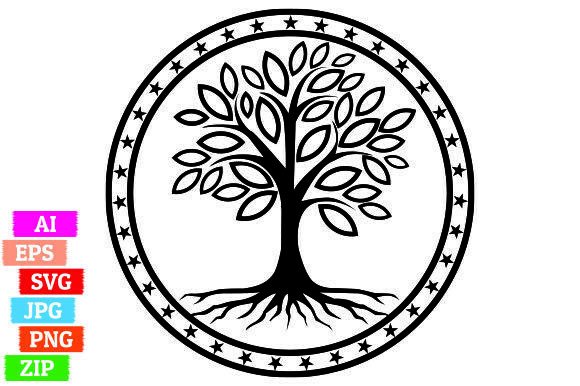
What makes this particular Tree of Life design uniquely valuable for professionals is its intentional construction for *use*, not just display. You will receive this design in the following formats:
- Editable AI file — Full vector control in Adobe Illustrator: adjust nodes, recolor branches, scale infinitely without loss, and integrate seamlessly into larger brand guidelines or pitch decks.
- Editable SVG File — Optimized for web and interactive applications: embed directly into dashboards, animate individual elements with CSS or JavaScript, and maintain responsiveness across devices.
- PNG File — High-resolution raster output ready for presentations, reports, or printed collateral—crisp at standard screen and print resolutions.
- Editable EPS File — Industry-standard vector format compatible with legacy and specialized design software, ideal for print production and cross-platform collaboration.
- Transparent PNG printable — Clean, background-free version optimized for overlays, watermarking, slide templates, or custom merchandise—no post-processing required.
All files are compressed in one ZIP folder—extract them or direct double-click to open instantly. No conversion steps. No compatibility hiccups. Just immediate utility.
This isn’t about decorative symbolism. It’s about having a foundational visual asset that adapts as your work evolves. A marketer building a content ecosystem can use the branches to represent channel strategies—email, SEO, social, podcasting—while anchoring each in shared audience insights (roots) and measurable engagement outcomes (fruit). A freelance UX designer might layer user journeys onto the trunk and branches, revealing where friction points intersect with emotional resonance. An educator could annotate leaves with learning objectives and fruit with capstone deliverables—making abstract pedagogy visibly scaffolded.
How It Fits Into Broader Professional Trends
The rise of the Tree of Life as a working tool reflects three converging shifts:
- From Linear to Networked Thinking: Traditional business models emphasized sequential processes—plan → build → launch → iterate. Today’s most resilient organizations think in networks: feedback loops, cross-functional dependencies, emergent behaviors. The Tree of Life visually encodes network logic without sacrificing clarity.
- From Generic to Values-Driven Expression: Consumers and collaborators increasingly evaluate brands—and individuals—by coherence between stated values and observable action. The Tree of Life provides a natural scaffold for demonstrating that alignment: roots (values), trunk (consistent execution), branches (diverse initiatives), fruit (measurable impact).
- From Static to Adaptive Assets: Professionals no longer want “one-size-fits-all” graphics. They need modular, editable components that reflect their unique voice and context. This design delivers exactly that—without requiring advanced design skills to modify or extend.
Consider how agencies now package strategy deliverables: instead of dense PDFs, they deploy interactive SVG-based Trees of Life embedded in Notion or Figma, where clients can click branches to reveal case studies, metrics, or team bios. Or how solopreneurs use transparent PNG versions as subtle watermarks on proposal slides—signaling depth, continuity, and intentionality before a single word is spoken.
Practical Integration: Where to Start
You don’t need to overhaul your workflow to begin leveraging this Tree of Life design. Start small—and scale with purpose:
- For marketers: Replace generic funnel diagrams with a customized Tree of Life—roots = audience insights and data infrastructure; trunk = core value proposition; branches = acquisition channels; leaves = campaign assets; fruit = LTV, referrals, and advocacy.
- For product leaders: Map your product evolution across seasons—spring (discovery), summer (growth), autumn (refinement), winter (consolidation)—using the tree’s natural rhythm to guide roadmap communication.
- For educators and trainers: Use the editable AI file to label each element with learning outcomes, resources, assessments, and reflection prompts—transforming abstract curricula into navigable, student-facing visuals.
- For freelancers and consultants: Embed the transparent PNG into your proposal cover pages or email signatures—not as decoration, but as a quiet signal of holistic, systems-aware practice.
What sets this apart from stock illustrations or templated graphics is its fidelity to function. Every curve, node spacing, and typographic hierarchy was designed to support legibility at multiple scales—from a mobile presentation to a 48-inch conference room display. And because it’s delivered in five interoperable formats, you retain full creative control without vendor lock-in or platform dependency.
A Framework That Grows With You
In a landscape saturated with disposable digital assets, the Tree of Life endures—not because it’s timeless in a static sense, but because it’s time-responsive. It expands to hold complexity. It contracts to clarify priority. It connects disparate ideas without flattening their uniqueness.
When you receive this design, you’re not just getting files. You’re receiving a thinking tool—one that supports clarity amid ambiguity, coherence amid change, and intentionality amid noise. Whether you’re architecting a new brand identity, structuring a cross-departmental initiative, or simply seeking a more grounded way to articulate your professional ethos, the Tree of Life offers both structure and space.
Its relevance isn’t accidental. It’s earned—through millennia of human sense-making, and now, through deliberate, practical adaptation for today’s most demanding creative and strategic work.