Happy Smiling Tooth Graphic: A Practical Evaluation for Designers and Marketers
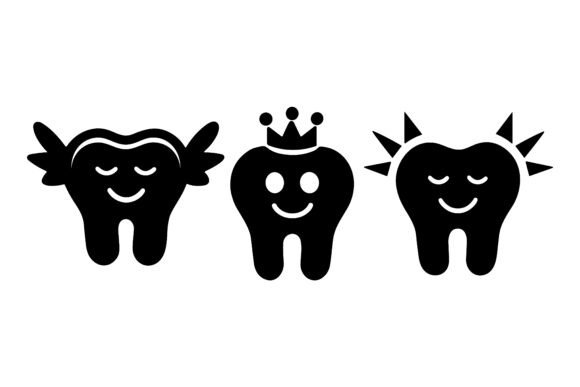
The Happy Smiling Tooth Graphic is a clean, silhouette-based vector illustration designed specifically for versatility across print, digital, and branding applications. Unlike photorealistic dental icons or hand-drawn sketches, this graphic uses simplified, balanced negative space and smooth contour lines to convey friendliness and approachability—without sacrificing professionalism. It’s not just a tooth; it’s a visual shorthand for oral health, wellness, positivity, and care, rendered in a way that avoids clinical sterility or childish oversimplification.
What Sets This Graphic Apart From Other Dental-Themed Visuals?
Most dental-related graphics fall into one of three categories: highly technical (anatomical diagrams), overly playful (cartoonish teeth with arms or hats), or generic clip art (low-resolution, rigidly styled, non-editable). The Happy Smiling Tooth Graphic occupies a deliberate middle ground. Its strength lies in its intentional minimalism—not stripped of character, but refined for clarity and adaptability. As a silhouette vector, it scales infinitely without pixelation, maintains crisp edges at any size, and supports precise color control—a practical advantage over raster-only alternatives like standard JPGs or PNGs with fixed palettes.
Crucially, the package includes an editable EPS file, which means designers using Adobe Illustrator or compatible vector software can adjust stroke weights, reposition elements, or isolate individual shapes—including the 100 vector components included. That level of modularity isn’t guaranteed with many stock dental icons, especially those sold as flat PNG bundles or locked SVG files with limited layer structure.
How It Compares With Common Alternatives
When evaluating visual assets for healthcare branding, educational materials, or wellness campaigns, users often consider several options:
- Free icon libraries (e.g., Flaticon, Noun Project): These offer broad selection and low cost—but most dental icons are either stylized beyond recognition or lack consistent line weight and spacing. Few include editable vector layers or high-DPI print-ready versions. Licensing terms also vary, and commercial use isn’t always included by default.
- Custom illustration services: Hiring a designer ensures full uniqueness and brand alignment—but requires time, budget, and clear creative direction. For projects needing a reliable, production-ready asset quickly—like a brochure series, social media toolkit, or clinic signage—the Happy Smiling Tooth Graphic offers a middle path: professional quality without the overhead.
- Photography or 3D renders: Realistic images work well for clinical contexts but rarely translate cleanly to small-scale applications (e.g., app icons or embroidered patches). They also introduce lighting, angle, and background dependencies that vectors avoid entirely.
In contrast, the Happy Smiling Tooth Graphic delivers consistency across formats. Its 300 DPI resolution and RGB color mode suit both web display and offset printing—no upscaling or color profile conversion needed. And because it’s delivered in ZIP format with multiple file types (EPS, JPG, and vector shape collection), users aren’t locked into one workflow or output requirement.
Real-World Use Cases and Practical Fit
This graphic performs best when clarity, scalability, and tone matter more than photorealism. Consider these scenarios:
- A pediatric dentist launching a new website might use the Happy Smiling Tooth Graphic as a recurring motif in banners, appointment reminder graphics, and printable activity sheets—adjusting colors to match their brand palette without redrawing anything.
- A public health nonprofit developing an oral hygiene campaign for schools could apply the same base graphic across posters, slide decks, and illustrated infographics—reusing the EPS file to generate monochrome versions for photocopying or grayscale printing.
- A product designer creating packaging for natural toothpaste might integrate the silhouette into a repeating pattern or use it as a subtle watermark—leveraging the 100 editable vector shapes to build custom arrangements rather than relying on static compositions.
It’s less suitable for contexts requiring medical accuracy (e.g., dental school textbooks) or strong narrative storytelling (e.g., animated explainer videos where motion and expression drive engagement). In those cases, custom illustration or licensed photography would better serve the objective.
Key Strengths—and Where It Has Limits
The primary advantages of the Happy Smiling Tooth Graphic are rooted in technical execution and flexibility:
- Scalability without compromise: As a true vector, it holds detail from billboard size down to a 16×16 favicon (with appropriate simplification).
- Workflow efficiency: The inclusion of both EPS and JPG files means immediate use in presentations or email headers, while retaining full editability for future refinements.
- Color adaptability: With 100 editable, color-changeable vector elements, users can create variations—pastel versions for children’s materials, bold primaries for community outreach, or muted tones for premium wellness brands—without sourcing new assets.
However, there are tradeoffs. Because it’s a single cohesive design rather than a full icon set, users needing complementary visuals (e.g., floss, toothbrush, smiley face, or gums) will need to source those separately—or adapt the existing shapes creatively. Also, while the EPS file is editable in Illustrator, users unfamiliar with vector paths may find initial customization steeper than working with drag-and-drop PNGs. Basic familiarity with anchor points, grouping, and layer management helps unlock its full potential.
Making the Right Choice for Your Project
Choosing the Happy Smiling Tooth Graphic makes sense when you value:
- Consistency across multiple touchpoints (print, web, merchandise);
- Control over color, scale, and composition without outsourcing;
- Speed in moving from concept to final output—especially for time-sensitive campaigns or iterative design rounds.
It’s less ideal if your project demands:
- Highly specific anatomical fidelity;
- A complete, coordinated set of related health icons;
- Animation-ready layered files (e.g., separate mouth, tongue, and teeth groups optimized for rigging);
- Multi-language or culturally adapted variants (e.g., different smile expressions for regional audiences).
Before committing, ask: Does this graphic support the tone and function I need—not just visually, but technically? Will it integrate smoothly into my existing tools and production pipeline? If the answer is yes to both, then the Happy Smiling Tooth Graphic provides measurable utility beyond aesthetics. It’s not a universal solution, but for many real-world design tasks, it strikes a practical balance between quality, flexibility, and accessibility.