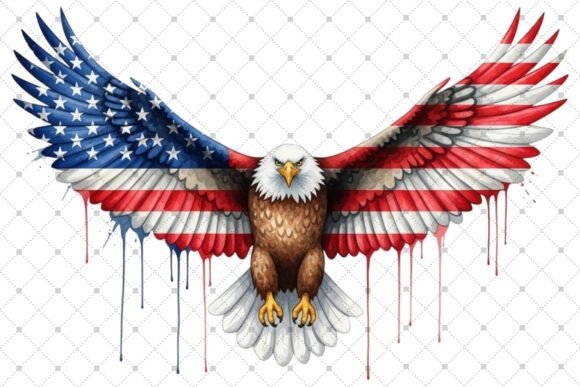
American Eagle with Patriotic Wings: A Digital Illustration for Meaningful Visual Expression
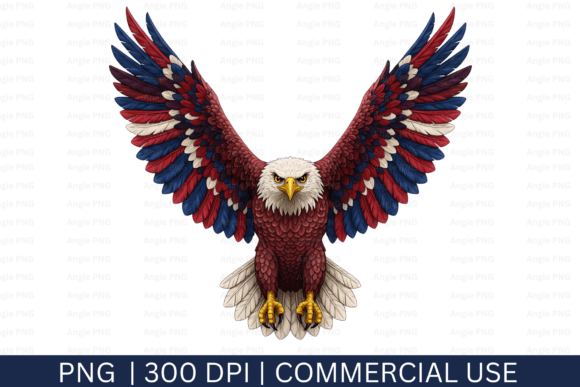
“American Eagle with Patriotic Wings” refers to a specific digital illustration — an eagle in mid-spread flight, rendered with wings composed entirely of the red, white, and blue elements of the American flag. Unlike stock photos of real eagles or generic vector icons, this design merges symbolic iconography with national identity in a cohesive, stylized composition. The result is a high-resolution PNG file with a transparent background, optimized for overlaying on websites, presentations, merchandise, social media graphics, or print materials without requiring additional editing.
What Sets This Design Apart from Other Patriotic Imagery
Many patriotic visuals fall into predictable categories: cropped flag close-ups, silhouette eagles, or layered photo composites with overt textures (e.g., weathered wood or parchment). The American Eagle with Patriotic Wings stands out because it treats symbolism as integrated design — not decoration. The feathers are not merely colored stripes; they’re arranged with directional flow, scale variation, and subtle contrast to suggest motion and dimension. The transparency of the background means it adapts cleanly across light and dark interfaces, unlike JPEGs or non-transparent PNGs that require manual masking or background matching.
This isn’t a photograph of an eagle wearing a flag scarf — it’s a deliberate visual synthesis. That distinction matters when selecting assets for professional use. For example, a nonprofit launching a Veterans Day campaign might need imagery that conveys reverence without cliché. A government agency updating its public outreach toolkit may prioritize clarity and scalability over ornamental detail. In both cases, the American Eagle with Patriotic Wings offers a middle ground: recognizable, respectful, and technically flexible.
How It Compares Across Common Use Cases
Digital illustrators, marketers, educators, and small business owners often evaluate patriotic assets along three practical axes: adaptability, tone alignment, and production efficiency. Here’s how the American Eagle with Patriotic Wings fits within those considerations:
- Adaptability: Because it’s delivered as a single high-resolution PNG with transparency, it scales cleanly from mobile app icons (when resized appropriately) to large-format banners. It avoids the rasterization issues common with low-DPI flag patterns or complex layered PSD files that require software-specific editing.
- Tone alignment: Its clean lines and balanced color distribution lend themselves to formal contexts — official announcements, educational materials, civic websites — without veering into militaristic or partisan associations. Compare this to more aggressive interpretations (e.g., eagles clutching missiles or shields), which narrow audience resonance and may limit reuse in diverse or neutral settings.
- Production efficiency: Users avoid time spent sourcing, licensing, or modifying multiple elements. There’s no need to composite a separate eagle image with a flag texture or adjust blending modes. One file, one layer, immediate integration.
Strengths and Real-World Tradeoffs
The primary strength lies in its focused intent: it communicates national symbolism through a singular, unified visual idea. That focus also defines its boundaries. It is not a customizable template — you can’t swap colors, reposition wings, or convert it to SVG without external tools. It is not animated, nor does it include alternate poses (perched, diving, or facing left/right). If your project requires dynamic interactivity or responsive morphing, this asset serves best as a static anchor rather than a modular component.
Also consider context sensitivity. While widely appropriate for U.S.-focused communications, its strong national association makes it less suitable for international-facing projects where neutrality or cultural inclusivity is prioritized. A university publishing a global research report, for instance, would likely choose a more universally legible symbol — such as a globe or open book — over even a tastefully rendered American Eagle with Patriotic Wings.
Another tradeoff involves artistic interpretation. Because the design follows a specific stylistic approach — flat but textured, symbolic but not cartoonish — it may not align with brands using highly minimalist, hand-drawn, or photorealistic visual systems. Matching it with supporting typography or color palettes requires intentional pairing, not automatic harmony.
When This Is the Right Choice — and When It Isn’t
The American Eagle with Patriotic Wings is especially well-suited for time-bound, mission-aligned initiatives where clarity and resonance matter more than stylistic novelty. Think: a local chamber of commerce designing Fourth of July event posters; a veteran service organization updating its website banner; or a school district creating printable classroom materials for Constitution Week. In each case, the audience recognizes the symbol instantly, the message is unambiguous, and the technical requirements (transparent background, crisp scaling) are met without extra work.
Conversely, it’s less ideal when flexibility outweighs immediacy. If you’re building a long-term brand identity system — say, for a new civic tech startup — you’ll likely benefit more from original illustration work tailored to your voice, values, and visual architecture. Similarly, if your audience includes broad age ranges or varying cultural backgrounds, a more abstract or inclusive symbol may foster wider connection than a nationally specific emblem — no matter how elegantly executed.
It’s also worth noting that “patriotic” doesn’t automatically mean “official.” This illustration carries no governmental endorsement or trademark status. It’s a creative interpretation, not a seal or insignia. Users should verify usage rights for their specific application — particularly in commercial contexts involving federal or military branding guidelines.
Practical Integration Tips
For best results, treat the American Eagle with Patriotic Wings as a focal point, not filler. Place it where visual hierarchy supports its role — centered above headlines, aligned to grid margins in presentations, or scaled to occupy roughly 20–30% of a social media post’s vertical space. Avoid stacking it over busy backgrounds or applying heavy filters that obscure the flag’s color integrity.
When pairing with text, choose typefaces with strong legibility and moderate contrast. Sans-serif fonts like Montserrat or Lato complement its clean lines without competing. Serif options like Merriweather or Georgia work well for printed materials where traditional gravitas is appropriate.
If adapting for accessibility, ensure sufficient contrast between the eagle and any adjacent text or background elements — especially since the red and blue portions may blend with certain UI colors. Testing against WCAG 2.1 contrast ratios is advisable before final deployment.
Making an Informed Decision Among Alternatives
Choosing among patriotic visuals isn’t about finding the “most American” option — it’s about identifying what best serves your audience, medium, and message. The American Eagle with Patriotic Wings excels when those needs include instant recognition, technical simplicity, and dignified execution. It competes less with other products and more with alternative approaches: custom illustration, licensed photography, or generative AI outputs.
Custom illustration offers full control but demands time, budget, and design expertise. Stock photography provides realism but often lacks symbolic cohesion or transparent backgrounds. AI-generated images may yield novelty but introduce unpredictability in composition, consistency, and licensing clarity. The American Eagle with Patriotic Wings sits between those poles — offering a known, vetted, production-ready solution grounded in intentional design.
In short, it’s not the only way to express patriotism visually — but for many practical, time-sensitive, or standards-conscious applications, it remains a thoughtful, efficient, and respectful choice.